 EN
EN

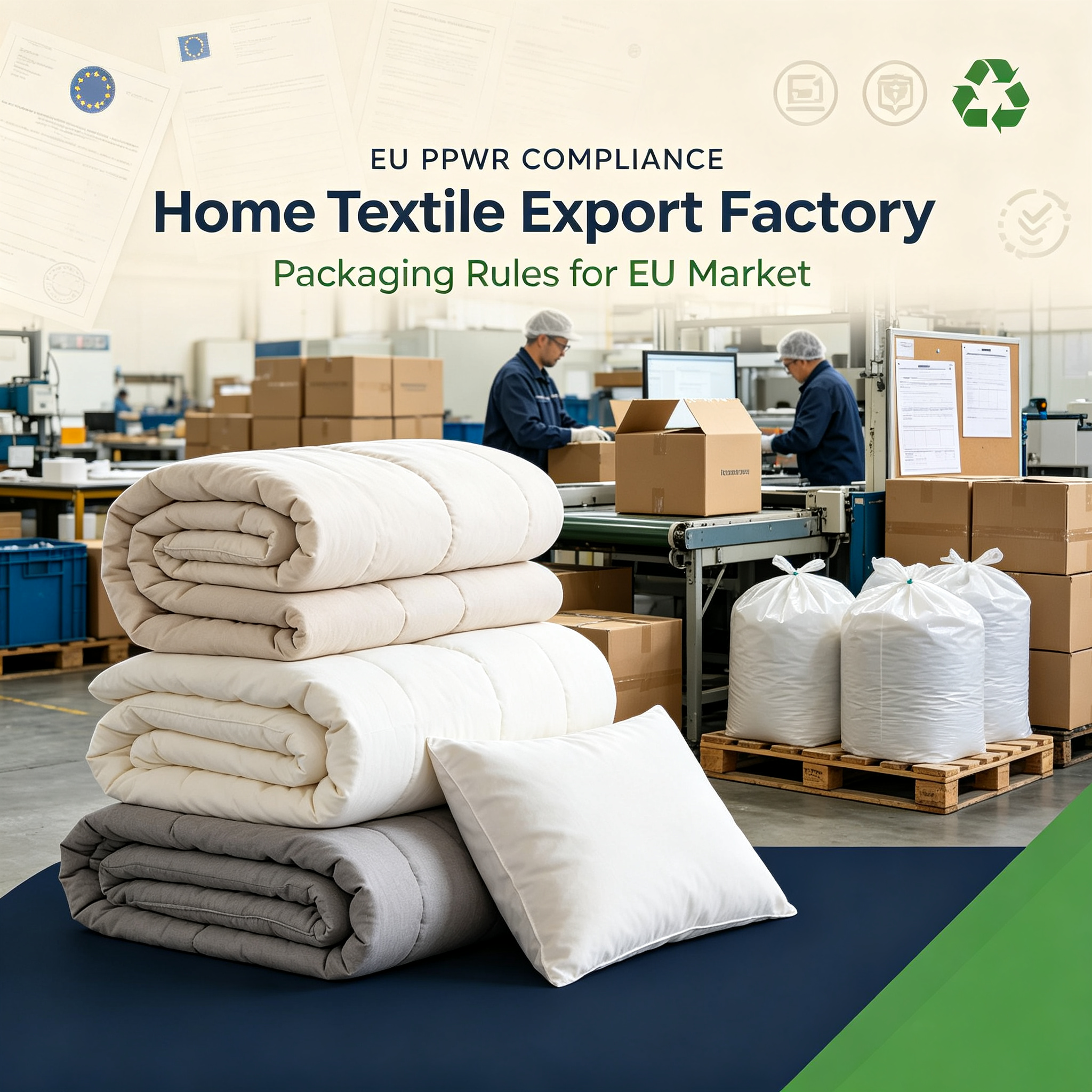
If you source bedding, mattress protectors, pillow covers or other home textiles from overseas factories for the European market, the new EU Packaging and Packaging Waste Regulation (PPWR, Regulation EU 2025/40) is no longer a distant future topic. Effective August 12, 2026, this new regulation applies directly across all 27 EU member states, replacing the old packaging directive that has stood for nearly 30 years. Unlike previous directives, there is no local‑level transposition; rules are unified and enforced evenly across the whole bloc.
Many buyers mistakenly believe PPWR applies only to finished textile fabrics. In reality, it governs all packaging accompanying your home‑textile shipments: transparent polybags for mattress protectors, printed export cartons, pallet stretch wrap, paper hang‑tags, adhesive stickers, tape, inserts and even inner protective packaging for bulk wholesale orders. Sales packaging, grouped secondary packaging and transport‑logistics packaging are all within scope. As a home‑textile OEM & ODM factory serving European clients, we have adjusted our whole packaging workflow to match these new legal requirements.
Core PPWR requirements that impact home‑textile supply chains
1. Substance limits inside packaging materials
A hard chemical limit applies to packaging components: combined lead, cadmium, mercury and hexavalent chromium shall not exceed 100 mg/kg total weight. This covers printing inks, carton coatings, glue and plastic films we commonly use for bedding sets. Recycled‑content cartons and colourful printed packaging carry higher risk of heavy‑metal non‑compliance, so we run regular third‑party lab tests for every packaging variant we deploy for EU orders.
Please note: PFAS restrictions mainly target food‑contact packaging at this stage. For regular home‑textile protective polybags, PFAS is not the immediate priority risk, while heavy‑metal compliance and full documentation remain our main focus.
2. No excessive packaging
Empty‑space thresholds are enforced for grouped, e‑commerce and transport packaging. Empty void may not exceed 50 % for grouped or shipping units, and sales packaging must keep void space to the practical minimum needed for product protectionIndustrie-.... For bulky home‑textile goods such as quilts, mattress covers and fitted sheets, we redesigned box dimensions and polybag sizing to avoid over‑sized packaging. We no longer apply redundant multi‑layer wrapping purely for visual presentation.
3. Mandatory technical documentation & Declaration of Conformity (DoC)
This is one of the most frequently underestimated obligations for non‑EU manufacturers. Before goods reach EU territory, complete technical documentation must be ready for market‑surveillance authority review upon request.
For each packaging type used in your order, our factory prepares:
- Full packaging bill‑of‑materials, covering every single component including inks and adhesives
- Valid lab‑test reports on heavy‑metal compliance
- Design justification proving packaging minimisation and recyclability considerations
- EU Declaration of Conformity issued per packaging specification
All records are retained for at least five years after shipment. Important reminder: PPWR does not issue official “certificates”. Compliance relies on self‑assessment plus supporting test evidence; importers and brand buyers should expect their overseas manufacturers to supply this full file set instead of chasing non‑existing PPWR certificates.
4. Traceability and upcoming labelling rules
Packaging must carry traceability identifiers such as batch‑code or style references, plus economic‑operator contact information. Where print space is limited, some information can be delivered via QR‑code or accompanying documents rather than printed directly onto small polybags.
Harmonised EU‑wide sorting‑recycling pictograms will become mandatory from August 2028, so we have already reserved space on carton artwork for future label updates, avoiding costly late‑stage redesigns when enforcement kicks in.
5. Clear distinction between PPWR and EPR
We frequently meet confusion among our partners: completing EPR registration in individual EU member states does not satisfy PPWR requirements.
- PPWR governs packaging material safety, design‑for‑recycling rules, void‑space control, test evidence and technical files. It applies to the physical packaging itself.
- EPR (Extended Producer Responsibility) is the waste‑management financing scheme handled by the EU‑based producer‑operator. It deals with reporting packaging weights and paying recycling fees inside each member nation.
Both sets of obligations must be fulfilled for market access. As the manufacturing factory, we deliver packaging‑side PPWR compliance; our EU‑based importer or brand customer takes charge of local EPR registration and reporting.
Practical changes we have implemented at our home‑textile factory
Running bulk OEM and custom‑wholesale production for EU retailers, Amazon sellers and hospitality procurement clients, we have rolled out tangible adjustments across our workshop:
- Packaging material screening: All new carton, polybag and printing‑ink suppliers must submit material‑safety declarations before being approved for EU‑bound orders.
- Packaging‑variant classification: We separate packaging specifications for EU shipments from other markets, so non‑compliant low‑cost packaging never gets mixed into EU‑targeted production lots.
- Pre‑shipment document workflow: Our QC team cross‑verifies packaging BoM, lab‑reports and DoC files before container loading, so documents are ready for buyers immediately upon order completion.
- Optimised packaging design: We balance product protection against void‑space rules for bulky bedding products. Where client branding allows, we increase post‑consumer recycled paper content for export cartons.
- Client‑side transparency: We share clear guidance for customers who supply their own custom packaging: customer‑provided packaging must also satisfy PPWR rules, and corresponding test‑reports and documentation should be supplied to our team ahead of mass production.
Common pitfalls for home‑textile sourcing
- Ignoring transport packaging: Pallet wrap, strapping bands and shipping cartons fall under PPWR, not only consumer‑facing retail polybags. Many suppliers only check inner retail bags and overlook tertiary shipping packaging.
- Reliance on supplier verbal claims: Words like “recyclable” or “eco‑friendly” do not equal PPWR compliance. Test reports and structured technical files remain mandatory proof.
- Last‑minute artwork changes: Printing updates close to shipment may alter ink‑formula and invalidate existing test data, creating compliance risk. We suggest finalising packaging artwork early for EU projects.
Closing thoughts
PPWR signals a shift in European market expectations: sustainability is no longer only about textile fabric certifications such as GRS, OEKO‑TEX. Packaging compliance has become a hard market‑access condition. Delays at border checks or market‑surveillance holds may happen if documentation or material requirements are not met.
As your manufacturing partner, our goal is to keep your home‑textile orders smooth and compliant. If you are planning new bedding, mattress‑protector or pillow‑cover projects for EU markets, we can walk you through our PPWR‑ready packaging options and document‑delivery process at your next project discussion.