 EN
EN

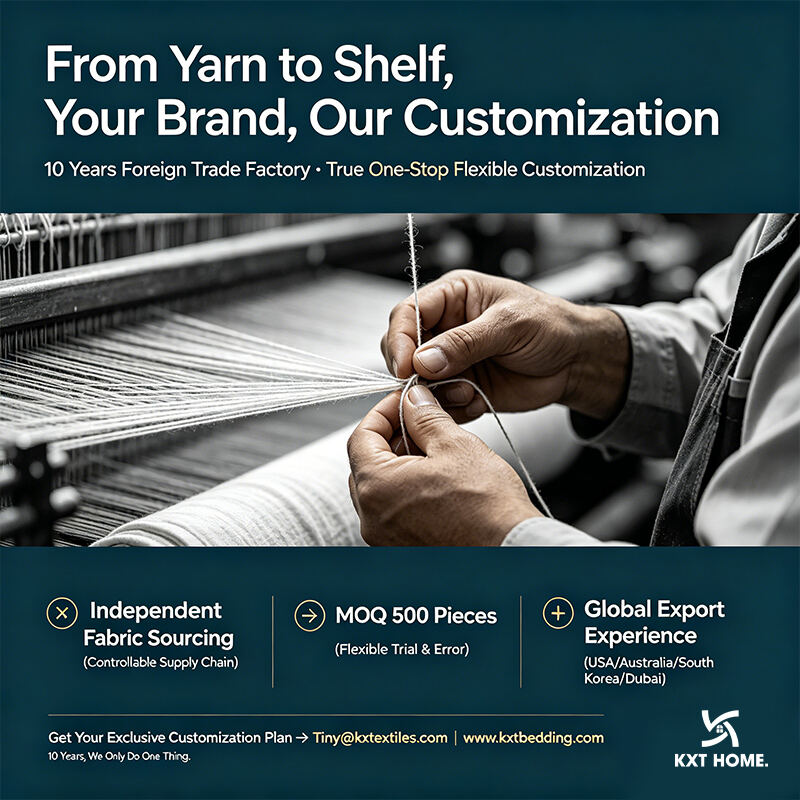
For retail brands looking to differentiate themselves in the competitive home textiles market, custom bedding is no longer a luxury—it’s a necessity. But the path from concept to finished product can feel like navigating a maze if you don’t know what to look for. After ten years in the game, we’ve seen what works and what doesn’t. Here’s the practical guide we wish every retail brand had before they started.
Why Customization Matters More Than Ever
Walk into any bedding aisle today and you’ll see the same patterns, the same color palettes, the same product descriptions. The brands that stand out aren’t the ones with the biggest marketing budgets—they‘re the ones that offer something their competitors don’t. Something that feels intentional. Something that tells a story.
For retail brands, custom bedding does three things: it builds brand recognition through consistent design language, it gives you control over quality and materials that off-the-shelf products simply can’t match, and it creates a genuine point of differentiation that customers actually notice. When a customer buys a bedding set that feels like it was made for them—because, in a sense, it was—they remember the brand behind it.
What True Customization Actually Looks Like
Here’s where things get interesting. True customization goes far beyond slapping a logo on a pillowcase or picking a color from a Pantone swatch.
At the fabric level, you’re making decisions that affect everything from how the product feels against skin to how it holds up after fifty washes. Thread count matters, sure, but weave type matters just as much—sateen for that silky drape, percale for crisp coolness, jacquard for intricate patterns that tell a story. We work with materials ranging from cotton Japara to Australian wool, and we’ve learned that the best fabric choice is rarely the most expensive one—it’s the one that aligns with your brand promise.
At the construction level, customization touches every seam. Piping or no piping? Double-stitched hems or single? The finishing details that most customers won’t consciously notice are exactly the ones that determine whether they perceive your product as premium or ordinary.
And at the production level, we’re talking about a complete process from sample development through scheme design to mass production. Multi-piece sets, personalized printing, size customization—these aren’t add-ons, they’re the core of what we do. For brands targeting specific markets, this means adapting to local preferences and cultural expectations, not just pushing a one-size-fits-all product.
The KXT Approach: A Factory That Actually Gets It
We’re not going to pretend we’re the only factory offering customization. But we will say this: there’s a difference between a factory that offers customization and one that’s built its entire operation around it.
Ten years of foreign trade experience means we’ve worked with brands across the United States, Canada, Australia, South Korea, Dubai, and beyond. Different markets have different expectations—what sells in Seoul doesn’t necessarily work in Sydney, and we’ve learned to navigate those nuances.
Integrated industry and trade isn’t just a buzzword for us. We control our own raw material procurement channels, which means we can guarantee supply chain security and cost control. When a brand asks for a specific material, we don’t have to go hunting for a supplier—we already have relationships in place.
Modern production lines combined with automated equipment means consistency. The fifth piece off the line should look exactly like the first, and the five-thousandth should look exactly like the fifth. That’s not luck—that’s quality control systems that actually work.
The Customization Journey: What to Expect
If you’re new to this, here’s what the process generally looks like:
Step 1: Discovery. We start with a conversation about your brand, your target market, your price points, and your vision. This isn’t a checkbox exercise—it’s where we figure out what’s actually achievable and what might need to be reimagined.
Step 2: Sample development. This is where concepts become tangible. We develop samples based on your specifications, and we don’t stop until the sample matches what you envisioned. Sometimes that means multiple rounds of refinement. That’s normal.
Step 3: Trial production. Before we scale up, we run a small batch to catch any issues that didn’t surface in sampling. This is also where we test production timelines and quality benchmarks.
Step 4: Bulk production. With everything validated, we move to full production. Our supply chain is set up to handle both rapid small-batch trial runs and large-scale production, which means we can be flexible as your needs evolve.
Step 5: Quality control and logistics. Every piece is inspected before it leaves the factory. Then it’s packaged, labeled, and shipped—whether that’s to a warehouse in Ohio or a distribution center in Rotterdam.
A Note on Minimum Order Quantities
Let’s address the elephant in the room. Many factories have MOQs that make customization prohibitive for smaller or newer brands. Our approach is more flexible. For logo customization, we typically work with a minimum of 500 pieces. But we also understand that brands need room to test and iterate—which is why we support flexible customization services that allow you to scale at your own pace. If you’re not sure whether a product will resonate with your audience, you shouldn’t have to commit to thousands of units to find out.
Real-World Application: What Customization Looks Like in Practice
Earlier this year, we shipped a batch of digital printing bedding sets to the Netherlands. The customization here wasn’t just about pattern—it was about color reproduction, material compatibility, and integration with the client’s existing production capabilities. The client needed products that could work with their digital printing infrastructure while maintaining the quality their customers expected.
Another recent project involved a European retailer looking for electric bed mattress covers—a specialized product requiring six-sided coverage with precise fitting and breathable materials. This wasn’t a standard catalog item. It required custom development, from fabric selection to production technique to quality testing. The client visited our factory, saw the process firsthand, and walked away confident in the partnership.
These aren’t isolated examples. They represent the kind of problem-solving that defines what we do every day.
Common Pitfalls to Avoid
After years of working with retail brands, we’ve seen the same mistakes crop up again and again:
Starting too late. Customization takes time—especially if you’re developing something from scratch. Factor in sampling, testing, and production lead times. If you’re planning a seasonal launch, start the conversation at least four to six months in advance.
Skipping the sample phase. We’ve had clients who wanted to go straight to bulk production to save time. It almost never works out. The sample phase exists to catch problems when they’re cheap to fix.
Not thinking about packaging. Custom bedding deserves custom packaging. Your unboxing experience is part of your brand story, and it’s worth investing in. We support custom packaging options, from PVC bags to branded cartons.
Forgetting about care labels. Those little tags matter. They communicate your brand’s attention to detail and they’re legally required in most markets. Make sure your care instructions, brand labels, and barcodes are all part of the customization plan.
Why Partner with a Manufacturer That Understands Retail
There’s a difference between a factory that produces bedding and one that understands what retail brands actually need. The former gives you a product. The latter gives you a partner who thinks about your sell-through rates, your inventory turns, and your brand positioning.
We’ve been in this business long enough to know that a successful partnership isn’t just about hitting MOQs and meeting delivery dates. It’s about understanding your market, anticipating your challenges, and solving problems before you even know they exist. That’s what sixteen years of experience looks like.
Getting Started
If you’re a retail brand exploring custom bedding for the first time—or if you’ve been burned by a supplier who promised more than they could deliver—we’d encourage you to start a conversation. Not a pitch. A conversation. Tell us about your brand, your customers, and what you’re trying to achieve. We’ll tell you what’s possible, what’s practical, and what might surprise you.
Because the best custom products aren’t the ones where a factory checks every box on a form. They‘re the ones where both sides bring their expertise to the table and create something neither could have made alone.
For inquiries about MOQ, pricing, or to discuss your next project, reach out to our team at [email protected] or visit www.kxtbedding.com.
Table of Contents
- Why Customization Matters More Than Ever
- What True Customization Actually Looks Like
- The KXT Approach: A Factory That Actually Gets It
- The Customization Journey: What to Expect
- A Note on Minimum Order Quantities
- Real-World Application: What Customization Looks Like in Practice
- Common Pitfalls to Avoid
- Why Partner with a Manufacturer That Understands Retail
- Getting Started