 EN
EN

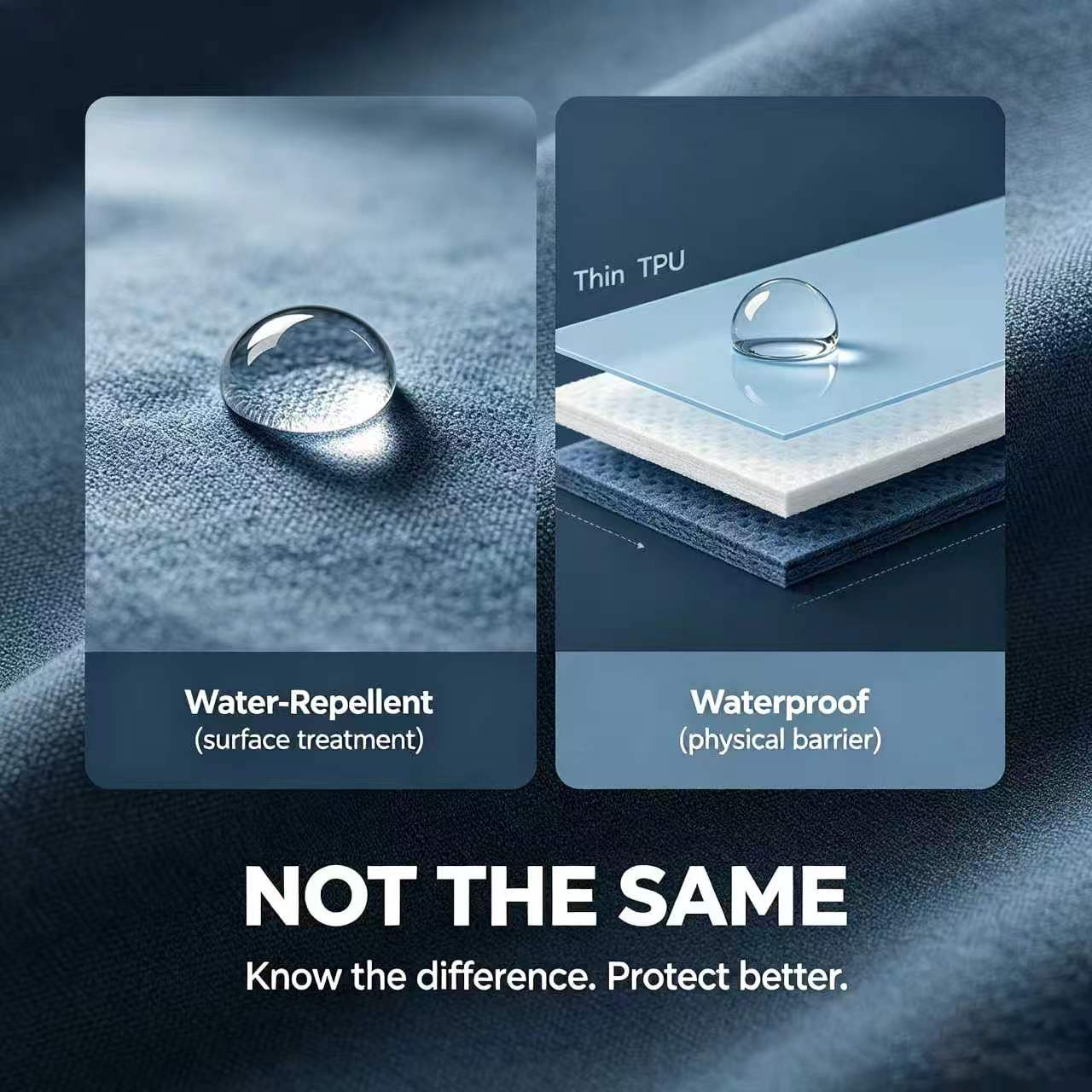
Waterproofing and Water Repellency Are Not the Same Thing. Here‘s What Every Mattress Protector Buyer Needs to Know.
If you’ve ever shopped for a mattress protector, you’ve probably seen the words “waterproof” and “water-repellent” used interchangeably. As a factory that has been manufacturing bedding protection for years, we see this confusion every single day—from retail buyers and sourcing agents right through to end consumers.
The short version? Water-repellent keeps water moving. Waterproof keeps water out. Period.
But if you’re sourcing mattress protectors for your brand, or simply trying to understand what you’re actually selling to your customers, the difference matters a lot more than a marketing label. Let’s break it down from the factory floor.
Water-Repellent: The Surface Treatment
Water repellency—often labeled as “water-resistant” or “DWR” (durable water repellent)—is a surface-level finish. In our production line, this means applying a hydrophobic chemical treatment to the fabric. The treatment lowers the surface tension of the fibers, so when water hits the fabric, it beads up and rolls off—just like water on a lotus leaf.
Here‘s what water-repellent doesn’t do: it doesn‘t create a barrier. The fabric still has pores. Air can pass through, moisture vapor can escape, but given enough time or enough liquid, water will eventually soak through. Think of it as a raincoat that works fine in a drizzle but fails in a downpour.
From a manufacturing standpoint, water-repellent finishes are relatively straightforward to apply. They’re common on the top surfaces of mattress protectors designed for light protection—think adult beds where the biggest risk is a splash of morning coffee or nighttime perspiration.
But there‘s a catch that every buyer should know: water-repellent finishes degrade. After multiple washes, the chemical treatment washes off or breaks down. The fabric’s surface tension changes, and suddenly that “water-resistant” protector starts absorbing liquid instead of repelling it. In our testing, we‘ve seen repellency drop significantly after just 10 to 20 wash cycles, depending on the chemistry used.
Waterproof: The Physical Barrier
Waterproof is a completely different animal. Instead of a surface treatment, true waterproofing relies on a physical barrier—a membrane or coating that sits within the fabric construction and blocks liquid penetration entirely.
In mattress protectors, this usually means a polyurethane (PU) or thermoplastic polyurethane (TPU) membrane laminated to the back of the fabric. This membrane has no pores large enough for liquid water to pass through. A spill, an accident, or even sustained moisture exposure—none of it reaches the mattress underneath.
Here‘s what makes waterproof fundamentally different from water-repellent:
Durability. A waterproof membrane doesn’t wash away. The barrier is physically bonded to the fabric, not chemically coated on the surface. While the top fabric may wear over time, the waterproof layer itself remains intact through hundreds of wash cycles.
Hydrostatic pressure. This is the industry metric that separates the two. Waterproof fabrics are tested by hydrostatic pressure—essentially, how much water pressure a fabric can withstand before water forces through. Industry standards consider 5000mm of hydrostatic pressure waterproof. High-end protectors in our factory routinely test at 10,000mm or higher. Water-repellent fabrics? They don‘t even register on this scale because they’re not designed to hold pressure—they‘re designed to shed surface water.
The breathability question. One concern we hear constantly from buyers: “Does waterproof mean hot and sweaty?” The answer depends entirely on the membrane technology. Older vinyl or PVC membranes were indeed hot, crinkly, and uncomfortable. But modern TPU membranes are micro-porous or hydrophilic—they block liquid water while allowing water vapor (sweat) to escape. In our factory, we’ve moved entirely to TPU lamination for this reason. It‘s quieter, more flexible, and significantly more breathable than older waterproofing methods.
The Factory Floor Reality
When a buyer comes to us and says “I want a waterproof mattress protector,” the first question we ask is: What does waterproof mean to you?
Because if what they actually need is a surface that beads water and feels light and airy, they might be better served by a water-repellent top fabric. If they need 100% liquid protection—for children’s beds, healthcare applications, pet owners, or hospitality environments—then they need a true waterproof membrane.
And here‘s something many buyers don’t consider: you can have both. Many of our premium protectors combine a water-repellent top surface with a waterproof membrane underneath. The top fabric sheds surface moisture and stays clean; the membrane provides the failsafe barrier. This dual-layer approach is becoming the industry standard for high-end products.
What This Means for Your Customers
If you‘re selling mattress protectors, your customers need to understand the distinction:
Water-repellent is for light, occasional protection. It’s breathable, affordable, and fine for adults who don‘t typically have accidents in bed. But it won’t save a mattress from a full glass of water or a child‘s overnight accident.
Waterproof is for real protection. It’s for households with kids, pets, elderly parents, or anyone who wants absolute peace of mind. Modern waterproof protectors are comfortable, quiet, and breathable—the old “plastic sheet” reputation is outdated.
The worst-case scenario? A customer buys what they think is a waterproof protector, has an accident, and discovers the liquid went straight through. That‘s a return, a refund, and a lost customer. Clear communication about what your product actually does isn’t just honest—it‘s good business.
From Our Factory to Your Brand
At our facility, we manufacture both water-repellent and waterproof mattress protectors, and we’re transparent about which is which. Every product that leaves our floor is tested—spray tests for repellency, hydrostatic pressure tests for waterproofing. We know exactly what each fabric can and cannot do.
So next time you‘re specifying a mattress protector, ask the question: Is this water-repellent or waterproof? And if the answer isn’t clear, keep asking until it is. Your customers will thank you—and so will their mattresses.
Have questions about our manufacturing processes or want to see our test reports? Reach out to our team. We‘re always happy to walk buyers through what goes into every roll of fabric that leaves our factory floor.